a chance
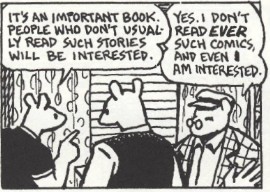
For me, personally, I enjoy reading thrillers, mysteries, something to keep me at the edge of my seat. I've always overlooked graphic novels and associated them with childishness and whatnot, and I'm sure many of my peers felt the same way. Even publishers had a hard time wrapping their heads around graphic novels' success when they first became popular.
By just flipping through the pages of Maus, you would see illustrations of different animals, and probably would immediately deem it as literature targeted towards kids. Before I came to class, I skimmed over the underlying clues, acknowledging the pictures as simply painting a picture for the reader to follow. However, after participating in class discussions, I realized how much you had to read between the lines, and how much thought goes into each individual panel. Especially with a novel like Maus, a glimpse into the life of a Holocaust survivor, the themes were very serious and dark, like racism, death, and guilt. The use of black and white also contributed to the dark theme, and by not using color, the author, Art Speigelman, was able to use shading to convey certain messages. With all this being said, it's clear that the target audience for this graphic novel is definitely not young children, but young adults or adults interested in learning about the Holocaust.
I think everyone should give graphic novels a chance - especially ones who discuss important matters, such as the Holocaust. Books don't have to be just words in order to consider them "serious" literature, as Maus, a novel that used both words and pictures, was one of the most serious books I have read. Don't simply dismiss things as "too childish," because you'll miss out on a lot of knowledge and great books, and no one likes someone who chooses to be ignorant.
Comments
Post a Comment